

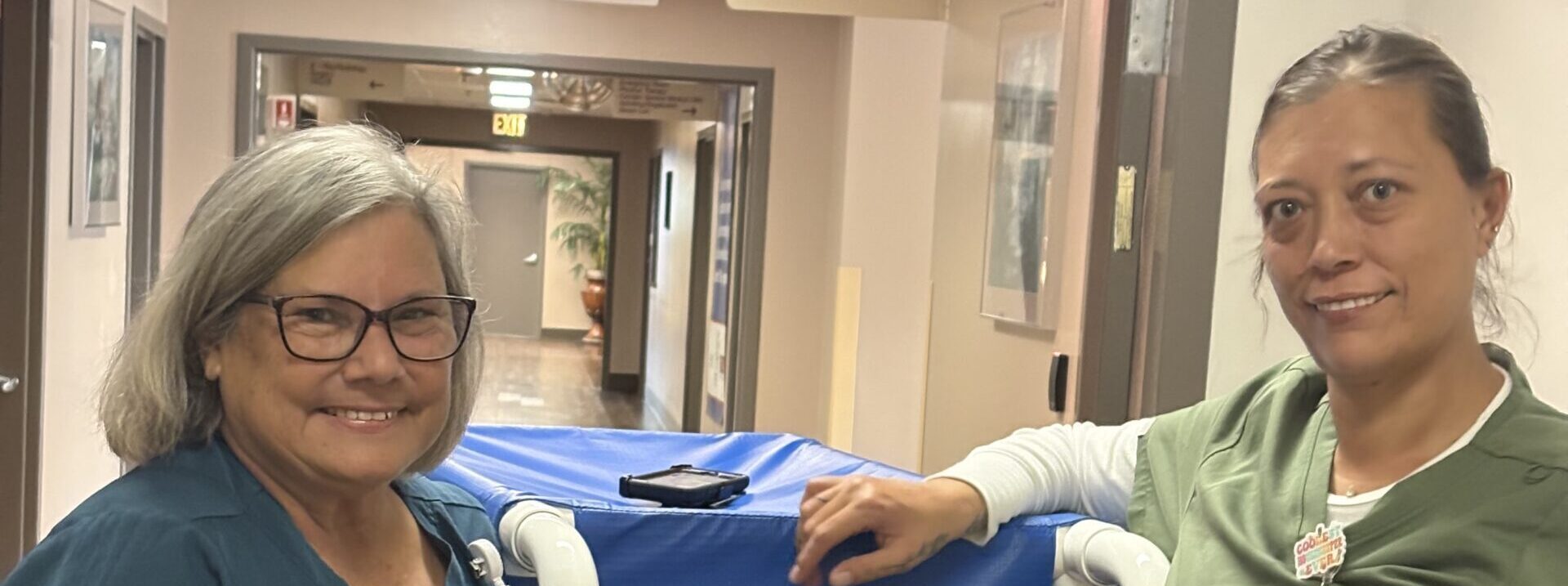
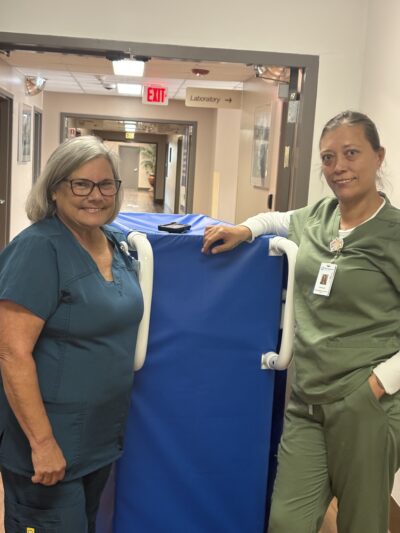
Ask Glenna Scott to rate the physical demands of her job on a scale of 1 to 10, and she
doesn’t hesitate. “12,” she says. Then she laughs.
It may sound like a joke, but anyone who has watched the Environmental Services team at
West Tennessee Healthcare Camden Hospital knows there is nothing simple about what
they do. They clean patient rooms, emergency department spaces, stretchers, restrooms,
and all the places most people never think about. They respond when accidents happen.
They deal with bodily fluids. They follow strict disinfecting protocols and know that
sometimes the difference between clean and properly disinfected comes down to
something as precise as how long a surface stays wet.
And, according to Scott, they are much more than the people who clean the hospital.
“They are the first line of defense,” she said.
That is the message Scott recently shared with her EVS team during a staff meeting. She
reminded them of a scene from Soul on Fire, a movie that stuck with her because of the
way it illustrates the importance of infection prevention.
“If they were not doing their jobs,” Scott explained, “then whatever infection this person
had would come in, and then the next person comes in behind them and they’re going to
catch that infection.” That responsibility is especially significant in the emergency
department, where rooms can turn over repeatedly throughout the day.
But Camden’s EVS department doesn’t have a large army of workers. Scott currently has
three full-time employees, with another registry employee in the hiring process.
Recently, the department faced an even greater challenge. Within two months, Scott lost
all three of her full-time employees around the same timeframe. For about a month, it was
essentially Scott and one registry employee keeping the department going. “We were
working like 50 to 60 hours a week,” she said. “But we got the job done!”
Scott describes her current staff as “self-starters.” They generally have assigned areas,
sign into their handheld devices when they arrive, and begin working through their cleaning
lists. They know their routines.
But they also have to know when the routine changes. A patient with C. difficile, for
example, requires different cleaning procedures, stronger chemicals and specific
equipment to help prevent cross-contamination.
“It’s a whole different thing,” Scott said. Sometimes the hospital doesn’t even know
immediately that a patient has an infection. “They may come in and say, ‘I’ve been
diagnosed with it,’” she said. “Or it may be the next day before we even know it.”
That is why, especially in areas such as the emergency department, EVS employees may
use enhanced disinfecting procedures as an extra precaution. “You just never know,”
Scott said.
“Seeing what others don’t”
The work is physically demanding, but Scott said one of the biggest challenges is getting
other people to understand just how much goes into it. She remembers a dietary employee
who helped the department during a staffing shortage.
After doing the job herself, the employee told Scott, “I did not realize what all you did.”
Scott wasn’t surprised. “You don’t realize until you do it,” she said.
There are obvious things, floors, bathrooms and surfaces, but there are also places most
people never notice. Scott points to the small “nooks and crannies” on stretchers and
equipment that can easily be overlooked. Those details matter.
So does understanding the chemistry behind the cleaning. EVS employees have access to
Safety Data Sheets for the chemicals they use, and Scott encourages them to ask
questions. Sometimes an employee will call her and say, “Hey, I had this happen. I’ve done
this. Is this the right thing to do?” Scott sees those questions as a good sign. “It’s a good
employee,” she said.
“You’re going to see all of it.”
Scott is also upfront with prospective employees about what they’re signing up for. During
interviews, she asks about their tolerance for bodily fluids and difficult cleanup situations.
Some applicants are surprised once they actually encounter the realities of hospital
cleaning. “I didn’t think I’d really see that,” they’ve told her.
Scott’s answer is straightforward. “Yeah. You’re going to see all of it.” One particularly
difficult cleanup took three EVS employees. Scott remembers the moment not with
displeasure, but with empathy. “It’s part of it,” she said. “Part of being human. Life
happens.” That perspective says a lot about the way she approaches the job.
“The kind of leader who pitches in”
Scott has been in her current role for two years, but her approach to leadership isn’t
complicated. When she hires people, she looks for personality. “Friendly personality.
Upbeat,” she said. Skills can be taught, she believes. “You can train anybody to do
anything,” Scott said. “But personality, you can’t train.”
She also doesn’t pretend to have every answer. “I don’t know everything,” she said. “And I’ll
be the first one to say I don’t know.” Instead, she asks her employees for their ideas. One of
the most rewarding parts of her job, she said, is watching an employee have an “aha
moment”, the instant when something clicks. “Everybody has a different view of
everything,” Scott said.
She takes those different perspectives and puts them together. “I may take something that
you said and then something you said and then something you said, and we put it all
together and we form what we’re going to do.”
It’s an approach that extends beyond management. Scott believes a leader shouldn’t ask
employees to do something she wouldn’t do herself. “I’m one of those,” she said, “I don’t
ask anybody to do anything I wouldn’t be willing to do.”
Recently, there was only one EVS employee in the building. When that employee went to
lunch or took a break and a page came through, Scott didn’t wait for someone else to
respond. She went herself.
“We can’t be everywhere.”
Perhaps the hardest part of EVS work is that there will always be more to do than people
realize. Scott’s message to patients and visitors is simple. “We can’t be everywhere all the
time.” But they try.
Behind every clean room is a checklist. Behind every disinfected surface is knowledge
about chemicals, contact times, and infection-control procedures. Behind every
emergency cleanup is someone willing to walk into a difficult situation and take care of it.
And behind that work is a small team that doesn’t always get noticed. Scott wouldn’t have
it any other way. After all, the goal of EVS is to do its job so well that most people never
have to think about it.
But the next time a patient walks into a clean hospital room, sees a freshly disinfected
stretcher or steps into a spotless hallway, there is a good chance someone from EVS was
there first. Someone like Glenna Scott. Someone who knows the work is a 12 out of 10.
And shows up anyway.


